
Nitetronic Lab
-

Smart Anti-Snore Pillow

Why Snoring Occurs?

Snoring is more thana sign of poorsleep quality; it is an independent risk factorforchronic diseasesand may indicateObstructive Sleep Apnea (OSA). It is common, affects sleepand causesdaytime fatigue, while also impactingrelationshipsand overallhealth.
Common attempts to eliminate the chance of snoring include anti-snoring month-piece, mouth strips, nasal dilators, and electronic stimulators, which areinvasivetools that contradictsleeping habits. They could create morediscomfortor incur additionaldamage.
-

Airway obstructed, snoring starts.
-

Turn head, open airway, reduce snoring.


"Head Position, separately from trunk position, is an additionally important factor for the occurrence of apnea in obstructive sleep apnea (OSA) patients."
Quantitative Effects of Trunk and Head Position on the Apnea Hypopnea Index in Obstructive Sleep Apnea.
- Ellen R. van Kesteren BSC,Nico de Vries, MD, PhD

"A Quantum Advance in PSG Recordings: The Importance of Head Position in Mediating the AHI."
Commentary on van Kesteren et al. Quantitative effects of trunk and head position on the apnea hypopnea index in obstructive sleep apnea.
- Richard J. Schwab, MD

Product Patent Declaration
Based onfundamental principles, experimental research, and clinical data, we have developed arange of anti-snoring products, including variouspillow designs. These products have undergonerigorous testingto ensureeffectivenessandsafety. As a result, we have successfully obtainedpatentsfrom the USPTO, securingintellectual property rightsfor our innovative technologies.

Nitetronic Smart Anti-Snore Pillow
Nitetronic Smart Anti Snore Pillow is equipped with MEMS sensors to monitor snoring and 6 flexible air chambers and 6 inductive position sensors to guide the head into a side-sleeping position. With advanced noise reduction and 10 years of AI algorithm validation, you will enjoy a snore-free and peaceful sleep.
How Nitetronic Smart Anti-Snore Pillow Works
Clinical Studies

Test of German users (2013)
Field Test Description
In a study of 157 participants (142 men and 15 women; average age 54±9.6 years), a significant reduction in snoring was observed. The amount of snoring time during the total recording time with the pillow deactivated decreased from an average of 48±17% to 16±9% when the pillow was activated, which represents an improvement of 67±14%.

67% Reduction in Snoring on Average
Test of German users (2013)
- Number of people tested: 157.
- The environment for testing: home.
- People use Nitetronic pillows for 2 nights and do not use Nitetronic pillows for 2 nights.

Significantly Rduced Snoring P < 0.03
ENT Clinic Of Mannheim, Heidelberg University, Germany (2014)
• Don't cause microarousal.
• Don't cause poor sleep parameters.
• Don't change the sleeping position on the back.
-

Pillow Activation Experiment
Activated anti-snore pillow reduces snoring by 67±13.9% (p<0.01) compared to 48±16.7% when inactive.
-

Bedmate Questionnaire Survey
After using the anti-snoring function, the snoring of bedmates significantly decreased, with the average decreasing from 2.8 to 1.9.
-

Bedmate and Self-evaluation
The bedmate evaluation scale shows that snoring significantly decreased after using the anti-snoring function (p<0.001).
-

Sleep Posture Impact
The anti-snoring function does not cause changes in the (whole-body) sleep posture, only the head movement.


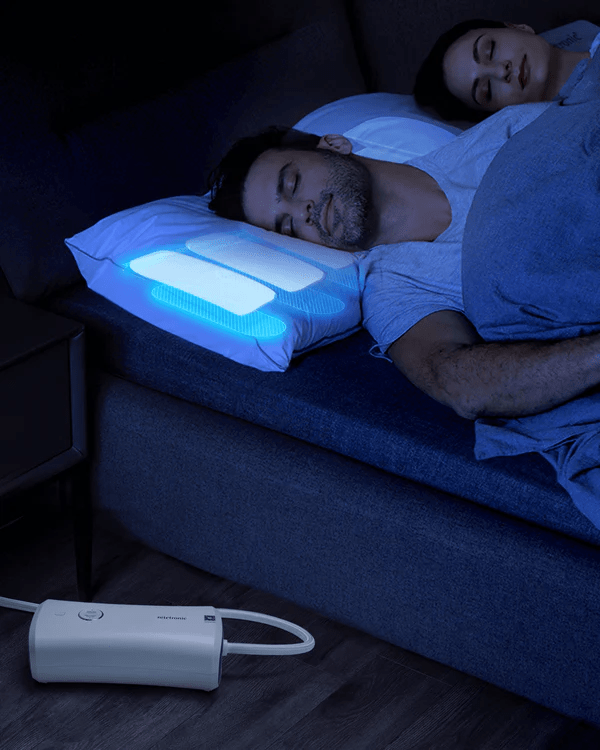
A Cost-Effective Snoring Solution - Side-Sleeping Anti-Snore Pillow
